
Name : Nurul Aini
NPM : 1910631060039
Class : 3C
Subject : Post Intermediate Reading
Saman Dance

Saman (or the dance of a thousand hands) is one of the most popular dances in Indonesia. Its origin is from the Gayo ethnic group from Gayo Lues, Aceh province, Indonesia, and is normally performed to celebrate important occasions. The dance is characterized by its fast-paced rhythm and common harmony between dancers. These two elements are key figures of Saman, and are among the reasons Saman are widely known and practiced in Indonesia, besides being relatively easy to learn.
On November 24, 2011, UNESCO officially recognized Aceh’s traditional Saman dance as an Intangible Cultural Heritage in Need of Urgent Safeguarding.
The ASEAN Tourism Association (ASEANTA) named the Saman dance as the best ASEAN cultural preservation effort at the 25th ASEANTA Awards for Excellence 2012.
Form
The dance is done by a group of people without musical instruments. Originally, the group was exclusively male. In performing this dance, the player sings some songs while doing some attractive movements. A short song (which leads to a short dance) can last for approximately 15 to 20 minutes.
Performance
A typical Saman performance is usually constituted of the following elements: The dancers enter the stage and immediately form a single line while sitting in a form equivalent to the Japanese seiza. The singer then begins to sing, with the lyrics at the beginning commonly telling the general attributes of Gayo culture at medium pace. The dancers then begin to move their hands in a rhythmic manner, following the movements. As the dance progresses, the movements are also performed with arms, head, and the upper body. The pace becomes faster, and the seat positions may change. The key element is that every dancer must move at the same time, creating a homogeneous, continuous, line of movement that is often described as the defining feature of Saman dance. One thing that makes this dance quite unique is that the original Saman dance which comes from Gayo Lues is not accompanied by any musical instruments.
Comment : This traditional dance originating from Aceh is very unique and interesting, the rhythm of the music is melodious and uses traditional Aceh clothes, and the movements are also quite easy to learn. but this dance requires high concentration and compactness between other dancers so that the person who dances it must really have these skills in order to present a beautiful dance for the audience.
Break Dance
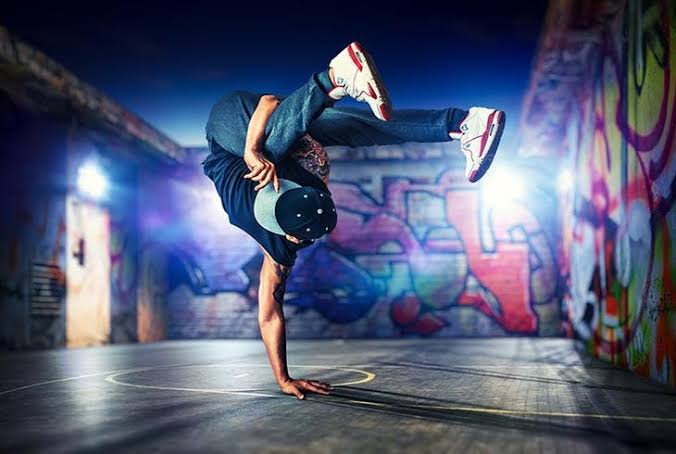
Breaking, also called break dancing or b-boying/b-girling, is an athletic style of street dance from the United States. While diverse in the amount of variation available in the dance, break dancing mainly consists of four kinds of movement: top rock, down rock, power moves and freezes. Break dancing is typically set to songs containing drum breaks, especially in hip-hop, funk, soul music and break beat music, although modern trends allow for much wider varieties of music along certain ranges of tempo and beat patterns.
Breaking was created by the African American youth in the early 1970s. The earliest 1st Generation break dancers of Bboys known as Trixie (Lauree Myers), Dancing Doug (Douglas Colon), A1 Bboy Sasa, The Legendary Smith Twins and Clark Kent. The groups included Zulu Kings, Star Child La Rock, Salsoul and Crazy Commandos. By the late seventies, the dance had begun to spread to other communities and was gaining wider popularity; at the same time, the dance had peaked in popularity among African Americans and Puerto Ricans.
A practitioner of this dance is called a b-boy, b-girl, or breaker. Although the term “break dance” is frequently used to refer to the dance in popular culture and in the mainstream entertainment industry, “b-boying” and “breaking” are the original terms and are preferred by the majority of the pioneers and most notable practitioners.
Dance Element
There are four primary elements that form break dancing. They are top rock, down rock, power moves, and freezes.
Top rock generally refers to any string of steps performed from a standing position. It is usually the first and foremost opening display of style, though dancers often transition from other aspects of break dancing to top rock and back. Top rock has a variety of steps which can each be varied according to the dancer’s expression (i.e. aggressive, calm, excited). A great deal of freedom is allowed in the definition of top rock: as long as the dancer maintains cleanliness, form, and attitude, theoretically anything can be top rock. Top rock can draw upon many other dance styles such as popping, locking, tap dance, Lindy hop, or house dance. Transitions from top rock to down rock and power moves are called “drops”.
Down rock (also known as “footwork” or “floor work”) is used to describe any movement on the floor with the hands supporting the dancer as much as the feet. Down rock includes moves such as the foundational 6-step, and its variants such as the 3-step. The most basic of down rock is done entirely on feet and hands but more complex variations can involve the knees when threading limbs through each other.
Power moves are acrobatic moves that require momentum, speed, endurance, strength, flexibility, and control to execute. The breaker is generally supported by his upper body while the rest of his body creates circular momentum. Some examples are the windmill, swipe, back spin, and head spin. Some power moves are borrowed from gymnastics and martial arts. An example of a power move taken from gymnastics is the Thomas Flair which is shortened and spelled flare in b-boying.
Freezes are stylish poses that require the breaker to suspend himself or herself off the ground using upper body strength in poses such as the pike. They are used to emphasize strong beats in the music and often signal the end of a set. Freezes can be linked into chains or “stacks” where breakers go from freeze to freeze to freeze in order to hit the beats of the music which displays musicality and physical strength.
Music
The musical selection for breaking is not restricted to hip-hop music as long as the tempo and beat pattern conditions are met. Breaking can be readily adapted to different music genres with the aid of remixing. The original songs that popularized the dance form borrow significantly from progressive genres of funk, soul, disco, electro, and jazz funk. James Brown, Jimmy Castor Bunch “It’s Just Begun”, and the Incredible Bongo Band “Apache” were used for break dancing. The most common feature of break dance music exists in musical breaks, or compilations formed from samples taken from different songs which are then looped and chained together by the DJ. The tempo generally ranges between 110 and 135 beats per minute with shuffled sixteenth and quarter beats in the percussive pattern. History credits DJ Kool Herc for the invention of this concept later termed the break beat.
Comment : This is a dance that we often see either in person or through electronic media, so that most people are familiar with this dance, but this dance is quite difficult and can only be done by people who really have skills in the art of dancing, generally the dance is performed by men but not a few women who do it. So for those of you who like to dance, you can try this dance or the traditional dance above :).
 nurullaini